


What is a Threat Intelligence Platform?
Most security teams are drowning in threat data but still can't answer the question that matters most: what does this mean for us? This guide breaks down how modern threat intelligence platforms turn raw feeds into automated defensive action - covering the full lifecycle from ingestion and enrichment to correlation, sharing, and AI-driven response.
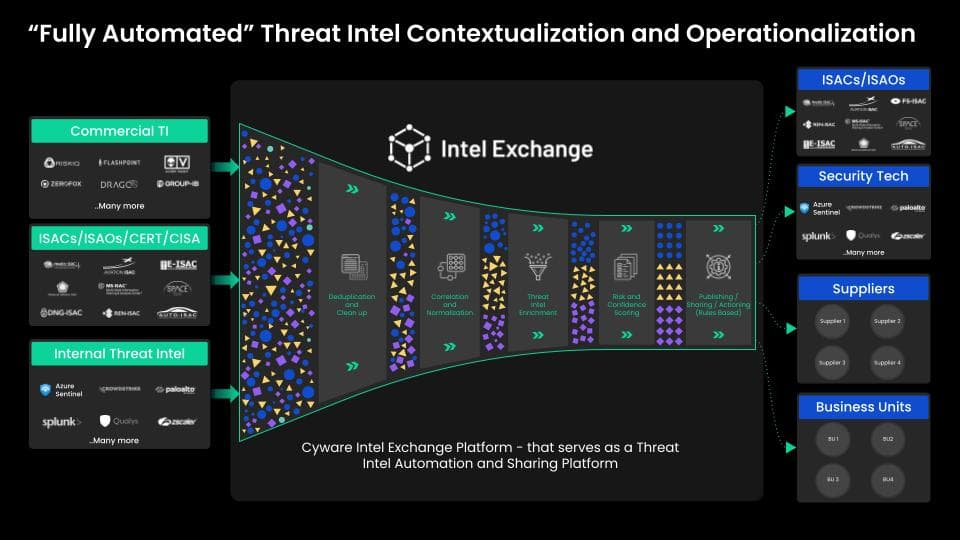
A Threat Intelligence Platform (TIP) is a cybersecurity solution that collects, aggregates, and organizes threat data from multiple sources to provide actionable insights. It enables security teams to identify, investigate, and respond to threats in real time. |
Overview
This is the definitive guide to threat intelligence platforms, management, and operationalization. Most organizations subscribe to dozens of threat feeds and ingest millions of indicators daily, yet struggle to answer a fundamental question: what does this mean for us? The problem is not a lack of data. It is the absence of a unified approach to turn that data into defensive action.
Full Lifecycle Automation: A modern threat intelligence platform automates ingestion, data clean up, normalization, enrichment, scoring, correlation, and actioning across SIEMs, SOAR, EDR, and firewalls, replacing manual processes that cannot keep pace with daily threat volume.
Agentic AI: Cyware AI enables autonomous orchestration across the intelligence lifecycle, from contextual enrichment and threat hunting to adaptive response workflows that adjust in real time.
Collective Defense: Cyware Collaborate enables bi-directional threat intelligence sharing across ISACs, ISAOs, CERTs, and private communities, turning isolated visibility into shared resilience.
Operationalized Intelligence: Intelligence moves beyond static reports into automated actions: blocking malicious indicators, updating detection rules, and triggering response playbooks at machine speed.
Evaluating platforms? Download the 2025 Threat Intelligence Buyer's Guide for a detailed framework on selecting the right solution for your organization.
What Is Cyber Threat Intelligence and Why Does It Matter?
Cyber threat intelligence is evidence-based knowledge about existing or emerging threats to an organization's digital assets. It provides context, analysis, and actionable recommendations that inform security decisions: Who might attack us? What are their capabilities? How do they operate? What vulnerabilities will they exploit?
Unlike raw logs or alerts, threat intelligence is refined information that has been collected, processed, analyzed, and contextualized for specific audiences. It covers technical indicators of compromise (IoCs) like malicious IP addresses and file hashes as well as strategic insights about threat actor motivations. Without it, security teams operate reactively. With it, they can predict attack paths, prioritize resources, and harden defenses before incidents occur.
How a Threat Intelligence Platform Works: The 6 Stages of the Lifecycle
A threat intelligence platform serves as the central nervous system of a security operations center. It manages the entire lifecycle of threat data. Without one, organizations struggle with data overload: thousands of indicators arriving across disparate feeds with no way to correlate or validate them.
The threat intelligence lifecycle is a repeating process that transforms raw data into actionable intelligence. Understanding each stage helps security teams build a program that continuously improves.
1. Direction
Define intelligence requirements. Identify which assets need protection, which threat actors are most relevant to your industry, and what questions your security program needs to answer.
2. Collection
Gather raw data from OSINT feeds, commercial vendors, ISACs, dark web monitoring, and internal telemetry. The goal is breadth of coverage without sacrificing signal quality.
3. Processing
Normalize, deduplicate, and structure collected data so it can be analyzed. This includes converting formats like STIX and TAXII into a unified schema and removing redundant indicators.
4. Analysis
Enrich and correlate processed data. Analysts and AI engines map indicators to adversary TTPs, assign confidence scores, and connect technical signals to broader threat campaigns.
5. Dissemination
Distribute finished intelligence to the right audience. Technical indicators go to SIEMs and EDR systems. Strategic summaries go to executives. Operational context goes to incident responders.
6. Feedback
Stakeholders review the intelligence they received and report back on its usefulness. This input refines future intelligence requirements and improves the quality of subsequent cycles.
What Are the Four Types of Threat Intelligence?
Strategic Threat Intelligence
High-level insights into threat trends, geopolitical factors, and long-term risk. Consumed by executives and board members for strategy and budget decisions.
Tactical Threat Intelligence
Focuses on adversary Tactics, Techniques, and Procedures (TTPs), often mapped to MITRE ATT&CK. Used by security architects and threat hunters to adapt defenses.
Operational Threat Intelligence
Context about specific campaigns, including intent and timing. Helps incident responders connect activity to known threat groups.
Technical Threat Intelligence
Short-lived indicators like malicious IPs, domains, file hashes, and URLs. Ingested by security tools for automated blocking and detection.
How Does Unified Threat Intelligence Management Reduce Alert Fatigue?
Many organizations mistake threat feeds for threat intelligence. An IP address flagged as malicious tells you nothing about whether it is relevant to your infrastructure or what priority it deserves among thousands of other indicators. Unified threat intelligence management turns raw data into actionable insight through four capabilities:
Ingestion: Structured evaluation of feed quality, elimination of redundancy, and format normalization. The goal is signal quality, not feed volume.
Enrichment: Adding geolocation, reputation scores, associated malware families, and targeted industries to raw indicators so analysts understand severity in context.
Correlation: The analytical engine where patterns emerge. A capable platform enables pivoting from an indicator to related threats, from a threat actor to their infrastructure, from a technique to affected assets. This correlation is a core function of a threat intelligence platform, enabling teams to pivot from a single indicator to a full adversary campaign.
Actioning: High-confidence indicators trigger automated blocking. Medium-confidence indicators generate alerts for review. Low-confidence indicators are logged for correlation without immediate action.
Why Is Threat Intelligence Processing Critical for Security Automation?
Processing is the connective layer between raw data collection and defensive action. Without structured, normalized data, automation workflows break down. Key processing functions include:
Normalization: Ensuring data from different sources can interoperate using standards like STIX/TAXII.
Confidence scoring: Assigning scores based on source reliability, temporal relevance, and multi-feed corroboration.
Internal correlation: Matching external threat data with internal logs to determine if a threat actor has already interacted with your network.
Deduplication: Removing redundant indicators across overlapping feeds to streamline analysis.
Well-processed data can be integrated into SIEM, SOAR, EDR, and firewall systems for automated blocking, alerting, and triage. Processing provides the foundation for intelligence-driven security orchestration.
What Are Threat Intelligence Feeds and How Do You Maximize Their Value?
Threat intelligence feeds are continuous streams of data about current and emerging threats. A simple subscription is insufficient. The value of feeds lies in active operationalization, not passive consumption.
OSINT feeds: Publicly available threat data. Cost-effective baseline, but higher false positive rates.
ISAC feeds: Sector-specific, high-fidelity intelligence from member organizations.
Commercial feeds: Curated analysis with reduced noise and implementation support.
Maximizing feed ROI requires a platform that normalizes formats, enriches with context, deduplicates indicators, and distributes intelligence to security tools in real time.
What Does It Mean to Operationalize Threat Intelligence?
Threat intelligence operationalization embeds intelligence into day-to-day SOC workflows. It is the difference between knowing about a threat and stopping it and is exactly what Cyware Intel Exchange is built for. Operationalization moves security from reactive to proactive by:
Automating the lifecycle from ingestion to action, so high-confidence indicators trigger immediate blocks at the firewall or EDR level.
Reducing Mean Time to Detect (MTTD) and Mean Time to Respond (MTTR) by providing analysts with pre-enriched, prioritized cases.
Orchestrating playbooks via SOAR to execute response strategies based on specific intelligence.
Tailoring dissemination: detailed technical data for analysts, strategic risk summaries for executives.
Why Is Threat Correlation Essential for Detecting Advanced Attacks?
Correlation links related data points across sources to identify unified threat events. It involves two dimensions: data correlation (linking technical indicators across logs, feeds, and alerts) and contextual correlation (mapping adversary behavior patterns to broader campaigns). Correlation helps security teams by:
Linking related alerts and enriching them with threat actor attribution and exploit availability.
Connecting tactical indicators to strategic campaign intelligence.
Revealing full attack chains for faster incident investigation.
Highlighting anomalies across historical and real-time data for proactive threat hunting.
Modern correlation engines use AI and graph analytics to map relationships, assign confidence scores, and visualize connections through network maps and timelines.
What Is Agentic AI and How Does It Automate Threat Detection and Response?
Agentic AI moves beyond rule-based automation. It uses autonomous agents capable of reasoning, learning from past incidents, and acting independently. In a threat intelligence platform, this means intelligence adapts continuously as threats evolve. Cyware AI powers the following agents:
Enrichment agents: Contextualize threats in real time with adversary profiles, ATT&CK mappings, and historical patterns.
Threat hunting agents: Scan telemetry around the clock to uncover threats that signature-based systems miss.
Correlation agents: Connect disparate signals into coherent attack narratives across environments.
Actioning agents: Adjust containment strategies dynamically if an attacker pivots tactics mid-campaign.
This creates a human-machine teaming model. AI handles scale and speed. Analysts focus on strategic decisions. Detection windows shrink from hours to seconds, and playbooks adapt in real time.
How Does Threat Intelligence Sharing Enable Collective Cyber Defense?
Cybercriminals share tools and techniques. Defenders need to do the same. Collective defense involves real-time sharing of threat data within industry communities and across sectors. Sharing networks operate through:
Hub-and-spoke models: A trusted authority (ISAC, CERT) aggregates and redistributes intelligence.
Peer-to-peer architectures: Direct exchange via STIX/TAXII without centralized intermediaries.
Hybrid approaches: Sector-specific hubs combined with bilateral sharing relationships.
Participation yields early warning systems, bi-directional sharing that strengthens collective resilience, and policy-driven collaboration that protects sensitive data while distributing actionable intelligence. Regulations like NIS2, DORA, and the Cyber Solidarity Act increasingly make sharing an operational requirement.
What Are the Steps to Building a Mature Threat Intelligence Program?
Define requirements: Identify critical assets and which threat actors are most likely to target your industry.
Select a platform: Choose one that supports unified management, deep integration, and AI-driven automation.
Consolidate feeds: Audit current feeds and focus on high-fidelity sources that provide context, not lists of IPs.
Implement processing: Automate normalization, deduplication, enrichment, and confidence scoring.
Operationalize via SOAR: Integrate the platform with orchestration tools to trigger automated responses.
Continuously improve: Use feedback loops from incidents to refine intelligence requirements and scoring models.
How Is the Future of Threat Intelligence Shifting?
The future of cybersecurity lies in the convergence of intelligence, automation, and AI. As threat actors adopt AI to scale their attacks, defenders must fuse detection, investigation, and response through a unified intelligence layer. Organizations that treat threat intelligence as a strategic capability will stay ahead. Those that leave intelligence in feeds and dashboards will keep reacting after the damage is done.
Explore the Cyware Intelligence Suite to see how a unified, AI-powered platform handles the full intelligence lifecycle: ingestion, enrichment, correlation, sharing, and automated response.
People Also Ask
What is the difference between threat data and threat intelligence?
Threat data is raw indicator output — IP addresses, file hashes, domains, and URLs — delivered without context or analysis. Threat intelligence is that same data after it has been processed, analyzed, correlated, and contextualized into something a security team can act on. The distinction determines whether your security program makes decisions or manages noise.
What is an Indicator of Compromise (IoC)?
An Indicator of Compromise (IoC) is a piece of forensic evidence that signals a system may have been breached or targeted. Common IoCs include malicious IP addresses, domains, URLs, and file hashes, along with host artifacts like registry keys and mutexes. IoCs are the most atomic, machine readable layer of threat intelligence, which is why security tools ingest them for automated blocking and detection. On their own, though, IoCs lack context: an IP address tells you nothing about who is behind it, what campaign it belongs to, or whether it is relevant to your environment. A threat intelligence platform turns IoCs into usable intelligence by enriching each one with context, scoring it for confidence, correlating it with related indicators, and routing high confidence indicators to enforcement tools automatically.
What are the primary sources of threat intelligence?
Threat intelligence is drawn from four primary source types, and most mature programs combine all of them. Open source intelligence (OSINT) is publicly available data such as security blogs, advisories, and public repositories, offering broad and cost effective coverage but higher false positive rates. Commercial feeds provide curated, vetted intelligence with reduced noise and vendor support. Sharing communities, including ISACs, ISAOs, and CERTs, deliver sector specific, high fidelity intelligence from trusted peers. Internal telemetry from your own SIEM, EDR, and firewall logs is often the most relevant source of all, because it reflects what is actually happening in your environment. The value does not come from the number of sources you subscribe to. It comes from a threat intelligence platform that normalizes, deduplicates, enriches, and correlates across all of them so analysts work from one trusted, contextualized view.
What is the intelligence-to-action gap in cybersecurity?
The intelligence-to-action gap is the delay between when a threat intelligence team produces or receives a threat indicator and when that indicator is actively enforced across security tools to block or detect the threat. In organizations without automation, this gap can range from hours to days — analysts must manually review IOCs, decide on their reliability, and then manually push them to SIEM rules, firewall block lists, and EDR tools. Every hour of this gap is a window where a known threat can operate uncontested. Closing the intelligence-to-action gap requires automated enrichment pipelines, confidence scoring, and direct integrations between the threat intelligence platform and enforcement tools, so validated indicators become active defenses in minutes rather than days.
What is the difference between threat intelligence enrichment and threat intelligence correlation?
Enrichment adds context to a single indicator, taking an IP address and adding geolocation, hosting provider, associated malware family, historical sightings, and MITRE ATT&CK technique mappings. Correlation connects relationships across multiple indicators, recognizing that an IP address, a file hash, and a phishing domain are all part of the same adversary campaign because they share infrastructure, timing, and TTPs. Enrichment answers 'what is this indicator?' Correlation answers 'how does this indicator connect to other threats we are tracking, and does it tell us something bigger than one indicator alone?' Both are essential: enrichment without correlation produces context-rich but isolated indicators; correlation without enrichment produces connected indicators that lack the depth to make response decisions.
What is the difference between ingesting threat intelligence and operationalizing it?
Ingesting threat intelligence means receiving data from feeds and storing it in a platform — the first 20% of the problem. Operationalizing means the remaining 80%: normalizing disparate formats into a unified data model, deduplicating overlapping indicators, enriching each indicator with context, scoring it for confidence and relevance, routing high-confidence indicators to the right enforcement tools automatically, and measuring which intelligence actually contributes to detections and prevented incidents. Many organizations have solved the ingestion problem but remain stuck at operationalization because they lack the automation, integrations, and feedback loops needed to close the intelligence-to-action gap. A platform that only ingests is a data repository; a platform that operationalizes is a force multiplier.
What is confidence scoring in a threat intelligence platform and how does it reduce false positives?
Confidence scoring in a threat intelligence platform assigns a numerical or categorical reliability rating to each indicator based on source trustworthiness, corroboration across multiple independent feeds, indicator age and recency of observation, and historical accuracy of the source. Indicators with high confidence scores trigger automated blocking and alerting. Low-confidence indicators are quarantined for analyst review or silently monitored without active enforcement. This scoring layer prevents the single most common failure mode in threat intelligence operations: flooding SIEM and EDR tools with thousands of unvetted indicators, generating massive false positive alert volumes that overwhelm analysts and erode trust in the intelligence program entirely.
How does automated threat intelligence actioning reduce mean time to respond (MTTR)?
Automated threat intelligence actioning eliminates the manual steps between receiving a validated indicator and enforcing it across security tools — the single largest contributor to high MTTR. Without automation, analysts review indicators manually, judge confidence, create tickets, log into each tool, and add indicators one by one — a process that takes 20 minutes to several hours per indicator. With automated actioning, high-confidence indicators are automatically pushed to SIEM detection rules, firewall deny lists, and EDR blocklists simultaneously the moment they are validated, compressing that sequence to under two minutes. Organizations with mature automated actioning pipelines report MTTR reductions of 60-80% compared to manual processes.
How does a TIP integrate with a SIEM?
A TIP feeds validated, high-confidence indicators into a SIEM as a real-time intelligence enrichment layer, filtering out low-quality IOCs before they generate alerts. In return, active SIEM alerts are enriched with TIP context — threat actor attribution, MITRE ATT&CK TTP mapping, and campaign history — enabling analysts to assess severity with full adversary context rather than investigating each raw log event from scratch. This bidirectional integration reduces false positive volume while increasing the intelligence value of every alert the SIEM escalates.
What is the difference between reactive and proactive threat intelligence operations?
Reactive threat intelligence operations apply intelligence after an alert or incident occurs — an analyst investigating a breach uses the TIP to look up indicators associated with the attacker. Proactive operations apply intelligence before an attack reaches the environment: tracking known threat actors targeting the sector, pre-deploying detection rules for their TTPs, updating firewall rules for their infrastructure, and briefing the SOC on current campaign activity before incidents occur. Proactive operations require ongoing threat actor tracking, regular intelligence production cycles, and direct integration between the threat intelligence team and the detection engineering function. The shift from reactive to proactive is the most significant maturity improvement a CTI program can make.